Design trends are funny. Every year, the internet fills up with articles listing 25 "trends you must follow" — most of which are either already everywhere or completely impractical for a real project with a real budget and a real deadline.
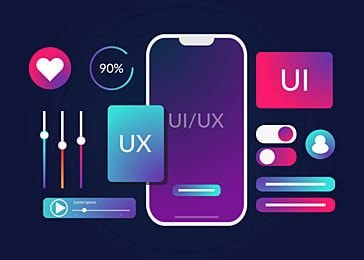
So I'm not going to do that. Instead, here are the UI/UX shifts that are actually making a difference in how websites perform, convert, and feel to real users in 2026.
Less Is Actually Converting More
There was a period where websites felt like they needed to prove their value through sheer volume — scrolling animations, full-screen video backgrounds, pop-ups, sliders, sticky banners, live chat bubbles. All of it fighting for attention at once.
The best-performing websites I've seen recently have largely abandoned that. Clean white space. One clear action per section. Typography that you can read on a phone without pinching the screen. The restraint is intentional — and it's working. Users are tired of noise, and the sites that respect their attention are the ones they stay on.
Dark Mode Is No Longer "Edgy" — It's Expected
A couple of years ago, dark mode UI felt like a choice brands made to look modern or creative. Now users genuinely expect it, especially for software, portfolios, and tech-adjacent brands. Operating systems offer it by default. Eyes have adjusted to preferring it in certain contexts.
If your website has no dark mode support at all in 2026, it's not a dealbreaker — but if you're targeting a younger, tech-literate audience, you're missing something they've already normalised elsewhere.
Micro-Interactions Are Doing Heavy Lifting
These are the small animations and responses that happen when you hover over a button, complete a form, or click something. A button that changes colour on hover. A checkbox that bounces slightly when ticked. A loading bar that feels smooth instead of jumpy.
Individually, none of these seem significant. Collectively, they make a website feel like it was built with care — and that feeling translates directly into trust. Users can't always articulate why a site feels good, but micro-interactions are usually a big part of the answer.
Mobile Navigation Is Getting a Rethink
The hamburger menu — those three horizontal lines that hide a navigation on mobile — has been the default for over a decade. But in 2026, designers are questioning whether it actually serves users well. Research consistently shows that users interact less with hidden navigation. More brands are experimenting with bottom navigation bars, persistent minimal menus, or search-first experiences.
This doesn't mean hamburger menus are "wrong." But it's worth asking: is hiding your navigation really the best choice for how your users actually use your site?
Typography Has Become a Design Element, Not Just a Readable Tool
Large, confident typefaces are everywhere in 2026 — used as visual anchors rather than just text to be read. Brands are using typography to convey personality in ways that used to require custom illustration or photography. One strong typeface used consistently does more for brand recognition than three mediocre ones used interchangeably.
Accessibility Is No Longer Optional
This is less a trend and more a correction. For years, accessibility was treated as a nice-to-have. In 2026, it's a baseline expectation — from Google, from users, and increasingly from legal perspectives in various markets.
Good contrast ratios. Alt text on images. Keyboard-navigable interfaces. Forms that work properly with screen readers. None of this is complicated, but all of it matters. And interestingly, accessible design almost always turns out to be better design for everyone — not just for the people it was originally built to serve.
The Bottom Line
Good UI/UX in 2026 is not about following trends — it's about removing friction. Every barrier between a user and what they're trying to do is a conversion you're potentially losing. The trends worth following are the ones that help you remove barriers, not add new visual complexity.
Your Website Design Might Be Costing You Customers
Our team at Digital Leaf designs websites that look great and actually perform. Let's take a look at yours and see what can be improved.
Get a Free Design Review →